Israel Wine Regions: A Map to the 850-Meter Binyamin Vines
In this article
- A Country Where Wine Regions Change Every Few Kilometers
- Where the Binyamin Mountains Sit on That Map
- How Israeli Wine Labels Actually Show You the Region
- From Coast to Desert: Three Climate Bands in One Small Country
- Why International Buyers Ask About the Binyamin Mountains by Name
- Meeting Beit-El Winery at the Hong Kong Wine Fair in November
- A Quick Checklist for Confirming a Wine's Region
Within the same small country, vineyards can sit at sea level or climb toward a kilometer above it, and that single fact explains more about Israeli wine than any tasting note ever could. Beit-El Winery sits near the top end of that range, at 850 meters above sea level in the Binyamin Mountains, a hill-country district most wine drinkers outside Israel have never heard named aloud. Understanding where that district fits on the national map is the fastest way to understand why a bottle from this elevation tastes nothing like a bottle grown twenty minutes toward the coast.
A Country Where Wine Regions Change Every Few Kilometers
Israel's wine industry is organized around a small number of regions used on export documentation and labels. Israel's wine classification system is built on five officially recognised geographical regions: Galilee, Judean Hills, Samson, the Negev, and the Sharon plain near the coast. Beyond these five, growers also recognize smaller hill-country districts, such as the Shomron Hills, even though these are often grouped under a neighboring region on formal paperwork.
For most of the twentieth century, the industry's center of gravity sat on the coastal plain. The coastal areas were the traditional wine regions, where the bulk of vineyards were originally planted, but with the quality revolution the vineyard areas moved northwards and eastwards in search of higher elevation, which is when the cooler areas of the Golan Heights, Upper Galilee and the Judean Hills became known for producing quality wines. The Binyamin Mountains sit squarely inside that later wave of hill-country planting, not the older coastal one.
Where the Binyamin Mountains Sit on That Map
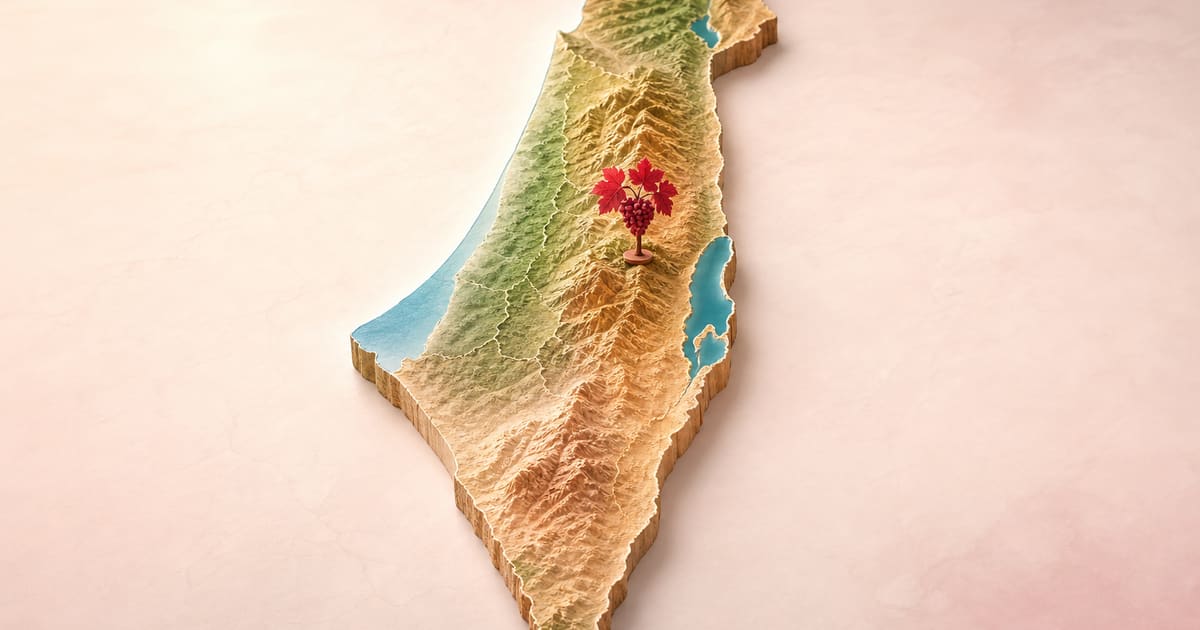
The Binyamin Mountains form the hill country directly north of Jerusalem, administered locally as the Mateh Binyamin region. Beit-El is a town in the Benjamin region of the central hill country, located in the hills north of Jerusalem. It has a higher elevation than Jerusalem itself, with cool nights in summer and occasional snow in winter. Those are exactly the conditions a winemaker wants on the slower-ripening end of a growing season.
This elevation is not unusual for the broader highland belt that runs through the center of the country. Nearby hill-country districts such as the Shomron Hills share similar shallow, limestone-based soils that growers consider well suited to wine grapes. Beit-El Winery's vineyards, at 850 meters above sea level, sit among the highest in that belt. The site also carries a layer of meaning beyond geography: it is the hill country where the patriarch Jacob is told, in the Torah, to have dreamed the dream that gives the Jacob's Dream series its name, a detail the Manne family built directly into how the wines are organized.
How Israeli Wine Labels Actually Show You the Region
Unlike French or Italian wine law, Israel's regional system mainly functions as an origin marker rather than a strict style rule. A region name on a label tells a buyer where the grapes grew, not necessarily what style to expect inside the bottle, which is why estate and vineyard names matter as much as the regional name itself.
The system is also still evolving in ways worth watching. In August 2020, the Judean Hills became the first area to receive the status of Israel's first official wine appellation, marking a step toward more precise geographic labeling. The Binyamin Mountains are not yet one of the five formally registered export regions, but the push toward finer-grained appellations suggests hill-country districts like this one may eventually be named with the same precision on international paperwork.
Want to hear more about The Manne Family's services?
Contact usFrom Coast to Desert: Three Climate Bands in One Small Country
A useful way to think about Israeli wine geography for a beginner is in three bands rather than five or six separate names. The coastal band includes the Sharon plain and parts of Shomron and Samson, where the Sharon plain near the Mediterranean coast, surrounding Zichron Ya'akov and Binyamina, is the largest grape-growing area in Israel. The hill-country band includes Upper Galilee, the Judean Hills, the Shomron Hills, and the Binyamin Mountains, all sharing the cooler nights that come with altitude. The desert band is the Negev, where growers rely on irrigation to make viticulture possible at all.
Beit-El Winery's vineyards belong firmly to the hill-country band, and a portion of the plots are farmed without irrigation, which keeps yields low and concentrates fruit flavor in the finished wine. That single growing decision, made plot by plot rather than across the whole estate, is one of the reasons the winery releases most of its wines as single-vineyard bottlings rather than one blended regional wine.
Why International Buyers Ask About the Binyamin Mountains by Name
A sommelier building a list for a luxury hotel, or an importer evaluating a boutique label for a market in Hong Kong, Mumbai, Seoul, or Tokyo, is rarely satisfied with a label that simply says Israel. A named district with a specific elevation and soil type gives the wine a provenance story that stands next to any other fine-wine region in the world, rather than being filed under a single generic national category. For a buyer stocking a hotel cellar or a private collection, knowing that a wine comes from 850 meters in the Binyamin Mountains, rather than from an unnamed coastal vineyard, is part of what justifies its place on a serious list.
Meeting Beit-El Winery at the Hong Kong Wine Fair in November
The Manne family will present the winery's wines at the Hong Kong wine fair this November, and the invitation extends in particular to importers traveling from Mumbai and Nashik in India, from Seoul, from Tokyo, and from Thailand and Singapore. For buyers in those markets who already carry boutique reds, tasting a wine alongside a clear explanation of its exact vineyard, elevation, and series is a faster way to judge fit for a list than reading a spec sheet alone. Those attending are welcome to taste across the five series side by side and ask directly about availability for their market.
A Quick Checklist for Confirming a Wine's Region
- Check whether the label names one of the five officially registered regions (Galilee, Judean Hills, Samson, the Negev, Sharon) or a more specific hill-country district within one of them.
- Look for an elevation figure; serious estates in hill country are usually specific rather than vague about altitude.
- Ask whether the wine is a single-vineyard bottling or a regional blend, since the two tell very different stories about the fruit.
- Note whether the plot is irrigated or dry-farmed, as this affects yield and concentration more than the regional name alone.
- Cross-check the stated region against the winery's own address or estate location rather than relying on marketing copy alone.
A map is only useful if it changes how a bottle gets chosen. For a buyer deciding between two red wines labeled simply 'Israel,' the question worth asking is not which country they came from but which hillside, at what elevation, and under whose hand. Those details are exactly what Beit-El Winery puts on the table from its site in the Binyamin Mountains.
FAQ
What are the official wine regions of Israel?
Israel's wine industry recognizes five officially registered regions used on export labels: Galilee, Shomron, Samson, Judean Hills, and the Negev. A sixth area, the Sharon plain, is widely used by growers though it is often grouped under Shomron on formal paperwork.
Is the Binyamin Mountains an official Israeli wine region?
Not currently one of the five formally registered export regions, but it sits within the hill-country belt bordering Shomron and the Judean Hills. Beit-El Winery's vineyards there sit at 850 meters above sea level, among the highest vineyard sites in that hill-country belt.
Why does elevation matter for Israeli wine?
Higher elevation generally means cooler nights and a slower ripening period, which helps grapes develop flavor and acidity without becoming overripe in Israel's warm climate. This is why the country's best-known quality regions moved toward the hills rather than staying on the lower coastal plain.
Where can international buyers taste Beit-El Winery's wines?
Beit-El Winery presents its wines to international buyers, most notably at the Hong Kong wine fair this November, where the Manne family welcomes importers from Mumbai, Nashik, Seoul, Tokyo, Thailand, and Singapore.
The Manne Family is here for you — get in touch.
Contact usHere's a ready-made Facebook post
Within the same small country, vineyards can sit at sea level or climb toward a kilometer above it, and that single fact explains more about Israeli wine than any tasting note ever could. What are the official wine regions of Israel?
https://beitelwinery.bizagent.me/a/israel-wine-regions-binyamin-mountains